Sunday, April 02, 2006

"A Look at Breed Stereo-types"

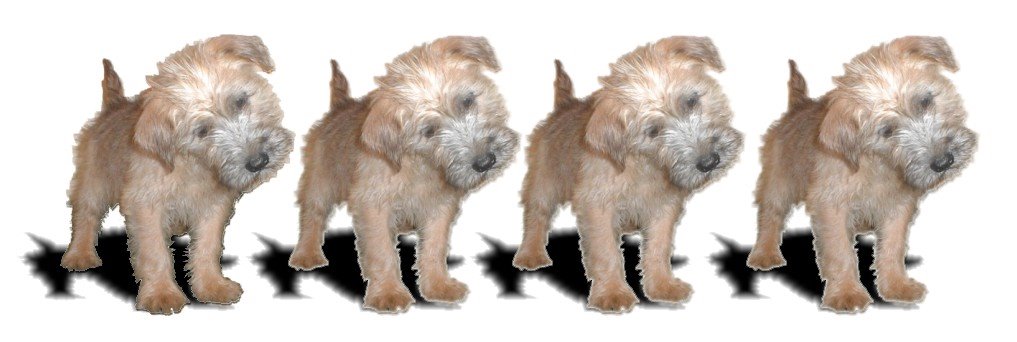
"Are Wheaton Terriers good family dogs?" It’s the type of question that begs other more poignant questions. For example, is it reasonable to paint any breed with a very broad brush? Do all Wheaton Terriers share the same essential traits? To answer both questions in the affirmative, these pups would have to come off an assembly line, from a single proprietary source. There would have to be strict quality control measures in place to insure consistency from one puppy to the next. Of course this is not the case and despite the efforts of experienced breeders to perpetuate the virtues of their chosen breed, there are plenty of puppy mills supplying your local pet stores with poorly bred dogs. Add back yard breeders to the mix and you've got yourself a fairly diverse gene pool with countless variations on a theme. That's why when I hear something like "Jack Russell Terriers are fearless" I think general statements of this sort are a little silly. (By the way, mine's a sissy) They can also create false expectations for your average pet owner.

Anyone who's watched the Westminster Dog Show has heard something to the effect of "The Portuguese Water Dog is...fill in the blank". This narrative unfolds as the best of that particular breed makes it's way around the show ring with their handler. What's assumed by the show's producer is that the audience understands what's being described is a breed standard as it applies to temperament. Now, if you prefer a more in depth examination, virtually every breed gets it's very own book. Each extols the virtues of the subject breed, both physical and behavioral. These books can be helpful if you're patient enough to find dogs who meet the breed standard but that's no easy task. Often what's described is a narrow band of a breed's actual population at any given time. Unfortunately the shows and the breed books are where a lot of once and future dog owners are gathering the information they'll use to begin looking for their next dog. Many dogs will go home with their new families and grow up as advertised. The rest , however, are a hodge podge brought to you courtesy of the aforemention gene pool. Good breeding is a tricky business, it may well qualify as an art form and raising a well-behaved puppy is hard work. You’d be ill-advised in fact, to consider one if you don’t have the time.


When someone asks me "Are Boxers good with children" my standard wise guy answer is "What Boxer are we talking about?" At one point during the summer of 2005 I found myself with five clients who had golden retrievers. Keeping in mind that this is the second most popular breed in the U.S. the odds were significantly better than say, five clients with Pharaoh Hounds. If I asked the question “Why are Golden’s so popular?” the most likely answer has something to do with a stereo-type that in this
case, is enjoyed by the breed. “They’re good family dogs”. Even if we forget for a moment that we’ve neglected to consider whether we’re talking about the Manson family or the Partridge family, just what exactly does that mean? In hindsight I remember these five goldens for the traits that made them individuals, in other words, what made them different from one another. They were, in fact, anything but carbon copies of each
other.


Breed stereo-types have begun to affect some dog owners in their wallets. Several insurance companies have begun to make it very difficult to own certain “dangerous breeds”. Why the quotation marks around “dangerous breeds”? Are the insurance companies just pulling these breeds out of thin air? Of course the answer is no, however, this is a “What came first, the chicken or the egg?” story. Does a Doberman puppy come into the world destined to pose a greater threat to humans than say a Labrador Retriever puppy? Can we examine that question without asking ourselves whether the stereo-types associated with each breed don't have an impact on who’s interested in them to begin with? By extension, might that have an impact on how they're being raised?


It wouldn't be right to cast a jaundice eye on breed stereo-types without shedding some light on better ways to look for your next dog. First, focus on temperment. In the February 26th issue of the Providence Journal, an article on so called "Designer Dogs" by Laura Meade Kirk quotes Jean McGroarty, executive director of the Animal Rescue League in Providence. In it she says, "When it comes to choosing a dog, people should go for temperament instead of looks or lineage." That's good advice. Second, leave the pet stores off your search list. The first question I ask prospective clients is, "Where did you get your dog?". No one who has purchased their dog at a pet store was asked the type of questions responsible breeders ask as a matter of practice. e.g. "What is the longest period of time the puppy will be left alone at home?" Pet stores do not evaluate for temperment and frequently purchase their puppies from dubious sources. Third, consider your local animal shelter. Petfinder.com is a virtual database of dogs waiting for homes in shelters around the country and near you. A growing number of shelters are evaluating the temperment of the dogs in their care. While these tests constitute no guarantee of good temperment they do provide valuable insight. Also, most, if not all breeds are represented by a rescue organizations and most if not all of these rescue organizations evaluate the temperment of the dogs in their care.


At the end of the day there's just no way to be absolutely sure what you're getting when you decide to bring a dog into your home. In the interest of full disclosure many of the dogs I work with that came from pet stores where smart, fun, physically healthy and by all accounts, wonderful additions to their respective families. Sadly, many of the dogs I see and work with at the Warwick Animal Shelter come from pet stores too; these poor souls are often the worst representatives of their breed. Plagued with health and behavioral problems, many don't find homes. While this post is intended to address stereo-types, pet stores play to the perceptions that constitute stereo-types. As a consequence they will alway figure heavily in any discussion of the subject.

Jim O'Neill
Great Dog K9 Training

Monday, March 27, 2006

“Tips for the Dog Park”

The City of Warwick allotted funds in 2005 for the designation of a fenced dog area at City Park. Thank you Mayor Avedesian, it's been an incredibly popular venue with an additional area added for smaller dogs. The Town of Barrington, RI followed with it's own designated area at Haine's Park. With the passing of Ballot Question 2 in this years election perhaps we'll see more of them.


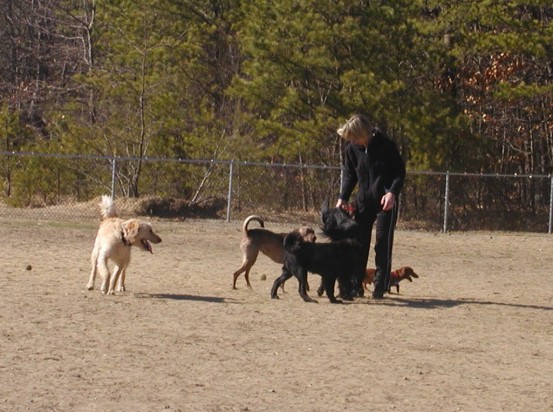
Dog parks are a great place for dog owners to observe the behavioral traits of their and other people’s dogs. I’ve been walking my dogs at City Park for several years. On a number of occasions I've observed people with their dogs walk nervously by other people with their dogs. You can only imagine what terrible scenarios their owner’s imagine might occur. Of course aggressive exchanges between dogs can and do happen so this sensation of impending doom is understandable, unfortunately owners tend to make mistakes like bunching up on the leash or changing the tone of their voice in a way that says to their dog, “Oh, boy, this might get ugly!” I can only imagine what a pleasant surprise it must be when they happen upon a dog park and all the dogs aren’t killing each other but playing instead. Of course having the freedom to move without the restriction of a leash dials back the tension levels considerably so aggressive behavior is far less likely to occur. That said, you’ve got to wonder if many dog owner’s first foray into the dog park isn't a little traumatic. Far more often than not their concerns are eventually appeased as their dog begins to greet and play with the other dogs. I enjoy watching dogs sort each other out. Dogs communicate so much to each other through body language and vocalization, it’s great fun watching the exchanges that unfold.


There are a handful of fundamentally important facts I enter the dog park with however. First, there is nearly always an element of aggression in dog play. Growling, barking and the baring of teeth are not unusual within the context of play. Second, if there is an aggressive exchange between two or more dogs it’s more likely to be a lot of pomp and circumstance (Think yelling and screaming) as opposed to them actually injuring each other. Dog’s have an innate sense of conflict avoidance, I believe this is vestigial and often refer to this type of behavior in that fashion. If they can impress upon an adversary that they should be left alone with a dramatic display as opposed to an actual exchange that includes biting, they are more likely to emerge from that situation uninjured; seems sensible right? Third, if they are injuring each other it will more than likely be over before you can do very much to prevent it. Your average dog can deliver five bites per second. If you’re getting the impression that a visit to the dog park should come with a measure of pragmatism I’d say you’re right. One of my three dogs, Reno, came from the Warwick Shelter with dog aggression issues. Training and conditioning that continues to this day, have yielded a dog that’s able to cope with dogs other than the two he lives with. I would not let him loose in a dog park. It’s just not reasonable to expect other dog owners to understand his dominant displays are not likely to lead to injury. There’s also no way to be certain that they wouldn’t! No one can be absolutely certain that other dog owners have asked themselves whether their dogs will behave well with other dogs and their human counterparts. Equally true is that no dog owner can say with absolute certainty that their dog is not capable of aggressive behavior. So what can you do as the human part of the dog park equation to keep the tension down and the atmosphere of fun up? Here are a few things I do. When I first posted this entry I suggested bringing treats into the dog park environment to establish a positive association. With the benefit of hindsight, that turns out not to be such a good idea. Many dogs gravitate to and frequently jump on the one or two people who do bring treats in. This can lead to injury and certainly creates tension which is not the objective here at all. Instead, think about using the space more effectively. With City Park as an example, the large dog area is 3/4 of an acre, the small dog area is roughly 2/3 of an acre. Both areas start with a small rectangular "lock", essentially a two stage entry into the larger areas. This is where problems can occur. If the larger area provides enough space for dogs to avoid conflict by walking (or running) away from it, the smaller is a potential powder keg. Enter only when it's empty. If someone else is coming in or out of it, wait for it to clear. Don't open the second gate until the one behind you is shut. Unleash your dog only after you've walked into the large area and do it quickly. Walk directly to the back of the area. Languishing near the entrance effectively abbreviates the park for your dog who will be inclined to stay near you. This is also where most of the other dogs are going to be and that's a recipe for stress. Walking to the back of the park opens it up and relieves the initial stress that comes when all the dogs already in the park want to see who the new dog is. Hang back and observe how frequently and how far your dog ventures away from you to mix it up with the other dogs. I do this to determine comfort level. Also observe when your dog looks back to make sure you're still there. I like to praise for this "Good Puppy", it lets them know I'm not stressed and will sometimes lead to a recall. If your dog responds to verbal praise by returning to you make sure to step up with vigorous physical praise as well.


What other behaviors should you be looking for when your dog’s at the dog park? Praise your dog for playing well with other dogs, praise your dog any time they’re near another person but not jumping on them; even chronic jumpers are going to miss an opportunity once in a while and when they do, accentuate the positive, let them know you noticed, “Good Dog!”, if you're close enough throw in a scratch on the tush. That'll begin to form the foundation of good, and from your dog’s point of view, rewarding behavior. What if your dog appears to be getting stressed out? One overly assertive pup is spoiling the fun. Call it a day before things get ugly but end on a positive note. If you’ve been careful to reward desirable behavior like eye contact and recalls with praise, then your dog is going to begin to recall more reliably. Call your dogs name, when they look, praise, when they come in, praise, leash say goodbye and try it again tomorrow.


In other parts of the country dog parks are fairly common, I’m confident you'll be seeing more of them in and around Rhode Island too, particularly as places like City Park begin to illustrate that they're not the risky proposition some thought they might be. The art of conversation, which has lost so much ground to modern distractions, is alive and well at City Park and places like it. "What sort of dog is that?" "What do you feed her?" "Who’s your vet?" "Hey, you know our dogs seem to like each other, what are you doing for dinner?" You get the picture. It’s great stuff. Civil discourse is part of this picture as well. Aggressive dogs, small children and food are best left outside the park but on occasion, find their way in. "Excuse me, your daughter doesn't look more than three years old. She could easily be injured in here" The presence of children in particular is both common and as the father of a 6 year old, disturbingly irresponsible and lacking common sense. Speak up! The accused may be belligerent at first but they're not likely to come back making the same mistake.

Jim O’Neill
Great Dog K9 Training
www.greatdogk9training.com